
Alexandria Amphitheater (Kom el-Dikka)


Located in the heart of Alexandria, Kom el-Dikka is an extensive Roman theatrical and residential complex. It includes the only known Roman amphitheater in Egypt, an impressively well-preserved structure composed of thirteen terraces. This was constructed  
in the traditional Greek style , with a flat stage in the center on the lowest level, and raised rows that ascend in steps surrounding three-quarters of the stage. The bench-style seats are all carved out of white or gray marble except for the first row, which is of red granite.  

Visitors can see, if they look very closely, the remnants of Roman numerals chiseled into each row. The oldest part of the theater consisted of approximately sixteen or seventeen rows of seats, allowing for an audience of 700 to 800 people. It was eventually expanded to  
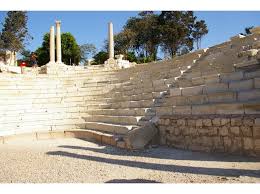
include exclusive boxes on the highest level for the upper echelons of society.
Current excavations at the edge of the site have uncovered Roman baths, lecture halls, and a small village, the centerpiece of which is the Villa of the Birds, a large house filled with beautiful mosaics. At the site is a small outdoor exhibition of Pharaonic and Greco-Roman era objects that have been found beneath the waters of the nearby harbor.
HOURS OF OPERATION:
Open daily, 8 AM “ 5 PM
Ramadan: 9 AM “ 4 PM

Comments

Popular posts from this blog

Tomb of Pabasa (TT279)

Pabasa, who was also called Pabes, has a large tomb at Asasif, just outside the entrance to Hatshepsut’s temple at Deir el-Bahri. Like Ankh-hor, who held this important title after him, he was the ‘Chief Steward of the God’s Wife Nitocris’ (Neitiqert) during the reign of Saite king Psamtek I.  Pabasa’s tomb still has a large mudbrick superstructure. A steep flight of stairs leads down to the entrance of the subterranean levels and on the lintel above the doorway is a fine relief of a barque, adored by the souls of Pe and Nekhen, by the God’s Wife, Nitocris and by the deceased.  A small vestibule leads to a larger pillared sun court. The vestibule shows scenes of Pabasa’s funeral procession, including mourners and the ‘Abydos Pilgrimage’. There is a long text of Pabasa and depictions of his son, Thahorpakhepesh, who acted as sem-priest at his father’s funeral.  On the inner lintel of the entrance to the court, a relief shows Osiris and Re-Horakhty, in the cent...

The bindweeds of Egypt and their symbolic role for the deceased

http://www.egyptraveluxe.com/cairo_half_day_tour_to_cairo_egyptian_museum.php From the Middle Kingdom until the 18th Dynasty, representations are found of a parasitic bindweed associated with the stems of papyrus, . Its representations increase and refine themselves during the Amarnian period because of the naturalistic leaning to nature; but it is in Ramesside times, and more particularly that of Ramesses II, that the images become more beautiful and most detailed. The plant is frequently attached to the stem of the papyrus, or to bouquets, but being also able to, more rarely, exist separately. After the 20th Dynasty, if the theme persists, the quality of the representations decrease (as do all more representations of nature). This success under the Ramesseses is probably linked with the specific beliefs of that time, and notably the eminent place that the solar cults occupy. The nature of the plant has been under debate a long time ...

US authorities return eight stolen ancient Egyptian artifacts

US authorities agreed to return eight ancient Egyptian artifacts stolen and illegally smuggled out of the country. Today, upon his arrival from the United States, Minister of Antiquities Mohamed Ibrahim announced that US authorities agreed to return eight ancient Egyptian artefacts stolen and illegally smuggled out of the country. The objects are to arrive next month. The pieces include the upper part of a painted anthropoid wooden sarcophagus from the Third Intermediate period depicting a face of a woman wea ring a wig decorated with coloured flowers. Two linen mummy wrappings covered with plaster and bearing paintings showing winged amulets pushing the sun disc are also among the artefacts. Hieroglyphic text showing the name and titles of the deceased are also found on the plaster cover. The third piece is a cartonage painted mummy mask from the Third Intermediate period while the fourth and fifth items are Middle Kingdom wooden boats. The other three items are lim...