

The Bayt Al-Suhaymi is an excellent example of a private, though wealthy, Egyptian home of the 17th century, and 
shows most of the features which made living in Cairo's arid climate tolerable in prior ages.
Not that the Bayt Al-Suhaymi is unique, but this house does provide an interesting perspective of history in 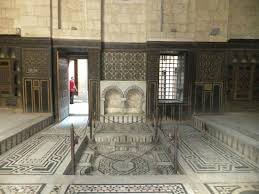 g
g
general, a concept which might be brought out here more easily than in other places. The concept is two fold. First, ancient arts and wisdom are lost due to modern invention and progressions, and second, that the ancient 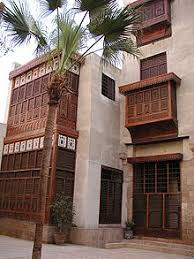
world, because of this, was a much more pleasant place to live than many believe (at least for those with some 
wealth). Bayt Al-Suhaymi is a case in point.

Other than the segregation between the men's (salamlik) and women's (haramlik) quarters, most of the spaces
within the house are not designed around

functionality, as houses are today, but around climatic considerations. During the heat of the day, shaded courtyards, balconies and roofs became the living areas, while in the cool of the night, the family would move indoors. We build houses today with low ceilings, and insulation from the exterior environs so that our 
refrigerated air conditioning may provide maximum benefits. But most of our modern houses would have been miserable dwellings in the distant past. While these people lacked our modern air conditioning, they developed 
other means, which are mostly lost to us, to make themselves comfortable. Within Bayt Al-Suhaymi we find high ceilings which allowed the warmer air to rise and then to be swept away by the north facing maq'ad (wind  scoops) in the upper walls which caught the prevailing breezes and circulated the cool air throughout the house. We find thick walls, cool marble floors and fountains, all of which kept the hot air from the Cairo summers at bay. Marble was in fact also used in similar ways to which
scoops) in the upper walls which caught the prevailing breezes and circulated the cool air throughout the house. We find thick walls, cool marble floors and fountains, all of which kept the hot air from the Cairo summers at bay. Marble was in fact also used in similar ways to which we use evaporative air conditioners, where water from fountains was cascaded over finned marble to cool the water. So while these people may not have had all of our modern conveniences, they did not suffer so much as 
we often believe from the absence of these conveniences.
The house was purchased in 1796 by Sheikh Ahmed as-Suhaymi, who extended it by integrating several of the adjacent houses. There are various separate staircase entries, and about thirty chambers, or qaa, on various 
levels. On the street side of the house, windows including that of the women's bedrooms, have mashrabiyya screens, while in the rear screened and latticed windows and arched galleries overlook the garden courtyard. The 
harem reception room is particularly lovely, overlooking the garden, its floors of marble, its walls covered with the most delicate green and blue plant patterned enamel tiles.
Comments
Post a Comment